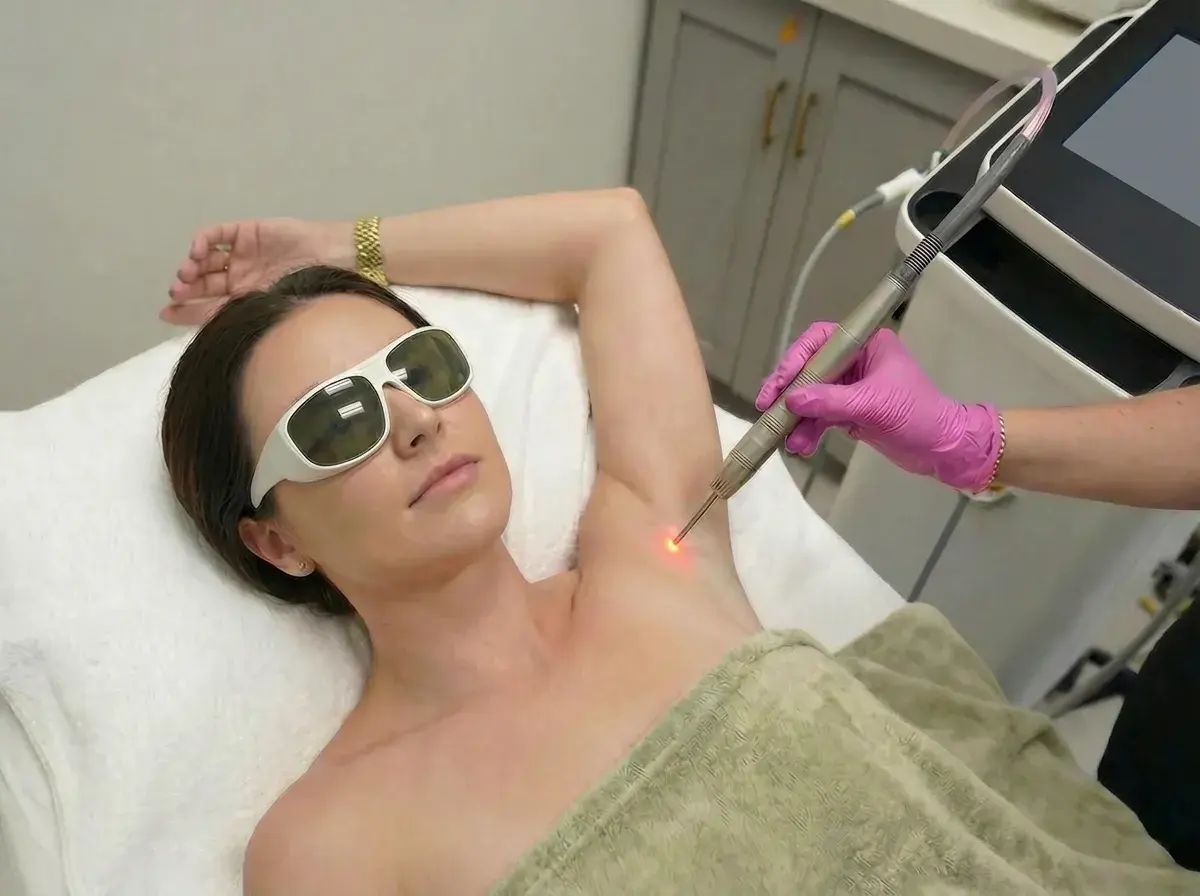
To choose the best laser hair removal in Pickering, check the device before the price: its wavelength, its cooling, and whether it is safe for your Fitzpatrick skin type. The 1064 nm Nd:YAG wavelength passes through pigment in the skin's surface and is absorbed by melanin in the follicle, so it suits light and darker skin. Built-in cooling protects the surface during each pulse. The second check is the operator, who sets the laser's parameters to your skin type and hair colour at a consultation. A realistic plan is 6 to 8 sessions, spaced 4 to 8 weeks apart.
How laser hair removal works
Laser hair removal treats unwanted hair with heat aimed at the follicle. The laser emits light at a single wavelength. Melanin, the pigment that gives hair its colour, absorbs that light and converts it to heat. The heat travels down the hair shaft and disables the follicle, which slows or stops new growth from it.
The wavelength decides where that light is absorbed. Shorter wavelengths are taken up strongly by melanin in the top layer of skin, which raises the risk of burns and pigment changes on darker or tanned skin. The 1064 nm Nd:YAG wavelength passes through that surface melanin and is absorbed by melanin in the follicle. Built-in cooling protects the skin surface while the follicle heats.
Only hairs in an active growth phase carry enough pigment at the root to respond, and every area holds hairs at different stages. That is why treatment runs as a series of sessions spaced weeks apart, with reduction building across the series.
What to look for in a Pickering laser clinic
Package price is the easiest number to compare and the least useful one. The device and the person operating it decide both safety and results. A clinic that cannot name its laser, or uses one setting for every skin tone, is a reason to keep looking. Check for these:
- A named laser and wavelength, with a clear reason it suits your skin. For darker skin, ask about 1064 nm Nd:YAG.
- Built-in cooling that protects the skin surface during each pulse.
- A trained operator who sets parameters to your Fitzpatrick type and hair colour and reviews them at each session.
- A consultation before the first session, with a skin assessment and a straight answer if your hair colour will not respond.
- A written plan covering the number of sessions, their spacing and likely touch-ups.
- A Health Canada-approved device for hair removal. Ask the clinic to confirm it.
Questions to ask at your consultation
Bring these to any clinic in Pickering or the wider Durham Region. Good answers are specific: a device name, a wavelength, a number of sessions. Vague answers on any of them are worth noting.
Compare prices once the device and the plan are settled. At Victoria Rose Aesthetics, current rates are listed on the treatment pricing page.
- Which laser do you use, and what is its wavelength?
- Is it safe for my Fitzpatrick skin type, and how will you set it for my skin and hair colour?
- Who performs the sessions, and how are they trained on this device?
- How many sessions will this area need, and how far apart?
- Will my hair colour respond, and what happens if it does not?
- What should I avoid before and between sessions?
- Will a hormonal area need touch-ups after the main series?
Who should not book, or should wait
Laser hair removal is a poor fit for some people, and others are safer waiting. The practitioner should screen for each of these at the consultation. Hearing that laser will not work for your hair is useful information. It saves the cost of sessions that cannot deliver a result.
- Tanned skin at the time of the session. A tan adds melanin to the skin surface, which absorbs laser energy meant for the follicle. Wait until it fades.
- Pregnancy. Treatment is postponed until after the pregnancy.
- Photosensitizing medication. Some medicines make skin more reactive to light, so bring a full list of what you take.
- Active infection in the treatment area. The skin needs to clear first.
- White, grey or very light blonde hair. These hairs hold too little melanin to absorb the light, and no setting changes that.
Laser hair removal at Victoria Rose Aesthetics in Pickering
Victoria Rose Aesthetics uses a Fotona Nd:YAG laser at 1064 nm with built-in cooling. That wavelength is suited to all Fitzpatrick skin types, including darker skin, so one device covers the full range of patients the clinic sees.
Sessions are performed by the clinic's Medical Aestheticians. Every plan starts with a $75 consultation of 30 minutes that includes a skin analysis. At that visit the aesthetician confirms your Fitzpatrick type and hair colour, sets the laser's parameters to both, and maps out sessions for each area. Full details are on the laser hair removal page.
The clinic is RN-owned and independent. Founder Victoria Rose Cyr, RN, BScN, sets the clinical standard the team works to. The Pickering clinic is at 1870 Altona Rd, Unit A, just off Highway 401 with free on-site parking, and sees patients from Ajax, Oshawa, Scarborough and across Durham Region.
Realistic results and maintenance
Most areas need 6 to 8 sessions, spaced 4 to 8 weeks apart so each visit reaches hairs entering their growth phase. Reduction builds gradually: roughly 25% after two sessions, 50 to 70% by sessions three to five, and 80 to 90% after a full series. That is long-term reduction, and a small share of hair usually remains.
Hormonal areas, such as the chin and jawline, can activate new follicles over time and may need one to two touch-up sessions a year. The practitioner reviews progress at each visit and adjusts the plan for the area. Results also depend on what happens between visits:
- Shave the area before each session.
- Avoid sun exposure and tanning beds before and between sessions.
- Stop waxing and plucking for the whole series. Both pull the hair from the follicle and leave the laser nothing to target.
Book a consultation in Pickering
A consultation is where the choice gets made for your anatomy and your history. Book a consultation at Victoria Rose Aesthetics in Pickering.
Victoria Rose Cyr, RN, BScN, is the founder and lead injector at Victoria Rose Aesthetics in Pickering, with more than ten years of clinical experience and over five years as a clinical trainer for Nuceiva and Teosyal.