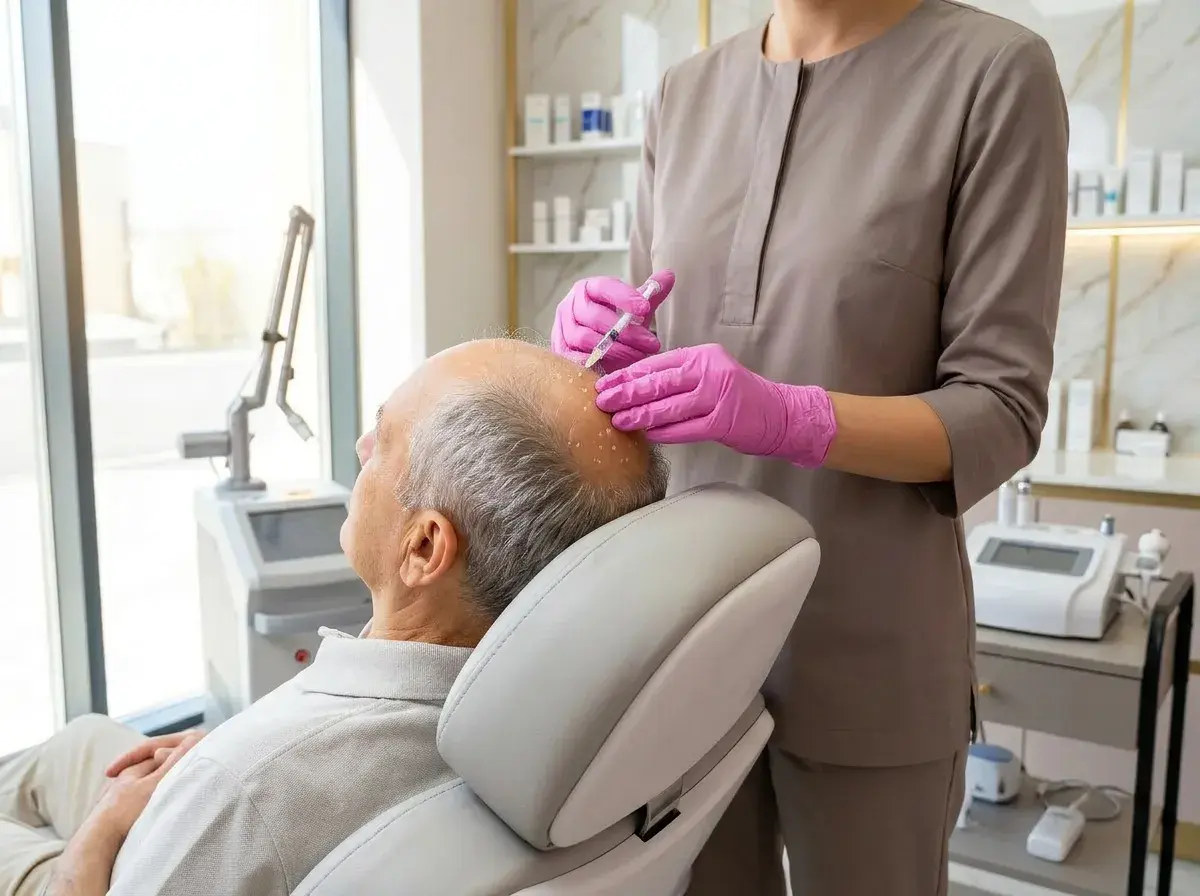
Choosing the best PRP hair restoration in Pickering starts with a scalp assessment that finds the follicles that are thinning but still active, because those are the only ones PRP can act on. PRP concentrates growth factors from your own blood and places them in the scalp, where they signal miniaturised follicles to return to the growth phase. A clinic worth booking assesses the scalp first, says plainly when a scarred or long-bald area will not respond, and explains how it prepares and places the plasma. This guide covers how PRP works, what to check in a clinic, who should wait, and what the treatment looks like in Pickering.
How PRP works on thinning hair
PRP stands for platelet-rich plasma. The practitioner draws a sample of your blood and spins it in a centrifuge for 10 to 15 minutes. Spinning separates the blood into layers, and the plasma layer carrying a concentrated number of platelets is drawn off for treatment.
Platelets carry growth factors, including PDGF, VEGF and TGF-beta. Once the plasma is injected into the scalp, these proteins signal miniaturised follicles to re-enter the growth phase of the hair cycle and help improve blood supply to the follicle. A miniaturised follicle has shrunk and produces finer, shorter hairs, but it is still alive. That is why it can respond. A scarred or long-bald area has no living follicle for the growth factors to reach.
The outcome follows from that mechanism, in order: shedding slows, new growth appears, then density builds. The same plasma preparation is used in PRP therapy and in microneedling with PRP. For hair, it is injected at the areas of thinning, and the hair restoration page covers the treatment.
What to look for in a PRP hair clinic
Because PRP acts only on living follicles, the first thing to check is how a clinic decides who is a candidate. A clinic that books a series without examining the scalp has skipped the step that predicts whether the treatment can work.
- A scalp assessment at consultation that looks at the pattern of thinning, how long it has been present and whether the skin is scarred.
- A plain answer when an area will not respond, such as scalp that has been bald for years.
- A stated preparation method: how the blood is drawn, how long it is spun and how the plasma is handled before injection.
- Injections placed across the mapped areas of thinning, recorded in your chart so later sessions treat the same zones.
- A written plan with the number of sessions, the interval and a review point.
- A health history that asks about blood disorders, anticoagulants, pregnancy and isotretinoin.
- Medical oversight, since the treatment involves a blood draw and scalp injections.
Questions to ask at a PRP hair consultation
The consultation is where the candidate decision gets made. These questions show whether the plan comes from your scalp or from a fixed package. A clinic that never turns anyone away tells you little about your own scalp. Bring a note of when the thinning started and any medications you take.
- Which areas of my scalp still have active follicles?
- Is my pattern of thinning one that PRP is used for?
- How is the blood prepared, and how long is it spun?
- Where will the plasma be injected, and how are those areas mapped?
- How many sessions do you recommend, and how far apart?
- What change should I expect to see first, and when?
- What would lead you to advise me to wait or to stop?
- What does maintenance look like after the first series?
- Can I see how the plasma is prepared on the day?
Who should not book PRP for hair, or when to wait
PRP suits early to moderate androgenic thinning, postpartum thinning and diffuse thinning where the follicles are still active. If you are still working out what is behind your thinning, the hair loss page covers the common patterns. The practitioner will advise against PRP, or ask you to wait, in these situations.
One honest limit applies to everyone. PRP works with the follicles you have. It cannot place new follicles in skin where none remain.
- Scarred follicles, including alopecia with scarring. Scar tissue has no working follicle left to signal.
- Long-standing bald areas, where the follicles have been inactive for years.
- A blood disorder or anticoagulant therapy, unless a doctor has given medical clearance first.
- An active scalp infection, which needs to clear before treatment.
- Pregnancy, which means waiting.
- Recent isotretinoin use, which needs to be raised at consultation.
PRP hair restoration at Victoria Rose Aesthetics in Pickering
Victoria Rose Aesthetics is an independent clinic at 1870 Altona Rd, Unit A, in Pickering, owned by Victoria Rose Cyr, RN, BScN. PRP hair restoration is performed in this RN-led clinic, and a Nurse Practitioner serves as Medical Director for regulatory oversight. The clinic serves Pickering first, along with Ajax, Oshawa and the wider Durham Region.
Treatment starts with a $75 consultation that includes a scalp assessment. The practitioner looks at where the thinning sits and whether the follicles in those areas are still active, then advises whether PRP fits and how many sessions to plan.
Each session runs 20 to 30 minutes. Directions and booking details are on the Pickering clinic page.
Realistic results and maintenance
PRP for hair is planned as a series. A typical plan runs 3 to 6 sessions, spaced 4 to 6 weeks apart.
The timeline follows the hair cycle, so change arrives in stages. Reduced shedding is usually the first sign, at 4 to 6 weeks. New growth tends to appear between months 2 and 4. Density builds by 4 to 6 months. Judge PRP at the 4 to 6 month mark, when density has had time to build.
Daily change is hard to see in a mirror. Photos taken before the first session give a fixed point to compare against at each review.
Results need upkeep. After the first series, an annual maintenance session helps hold the density gained. The practitioner sets that timing at review, based on how your scalp has responded.
Book a consultation in Pickering
A consultation is where the choice gets made for your anatomy and your history. Book a consultation at Victoria Rose Aesthetics in Pickering.
Victoria Rose Cyr, RN, BScN, is the founder and lead injector at Victoria Rose Aesthetics in Pickering, with more than ten years of clinical experience and over five years as a clinical trainer for Nuceiva and Teosyal.