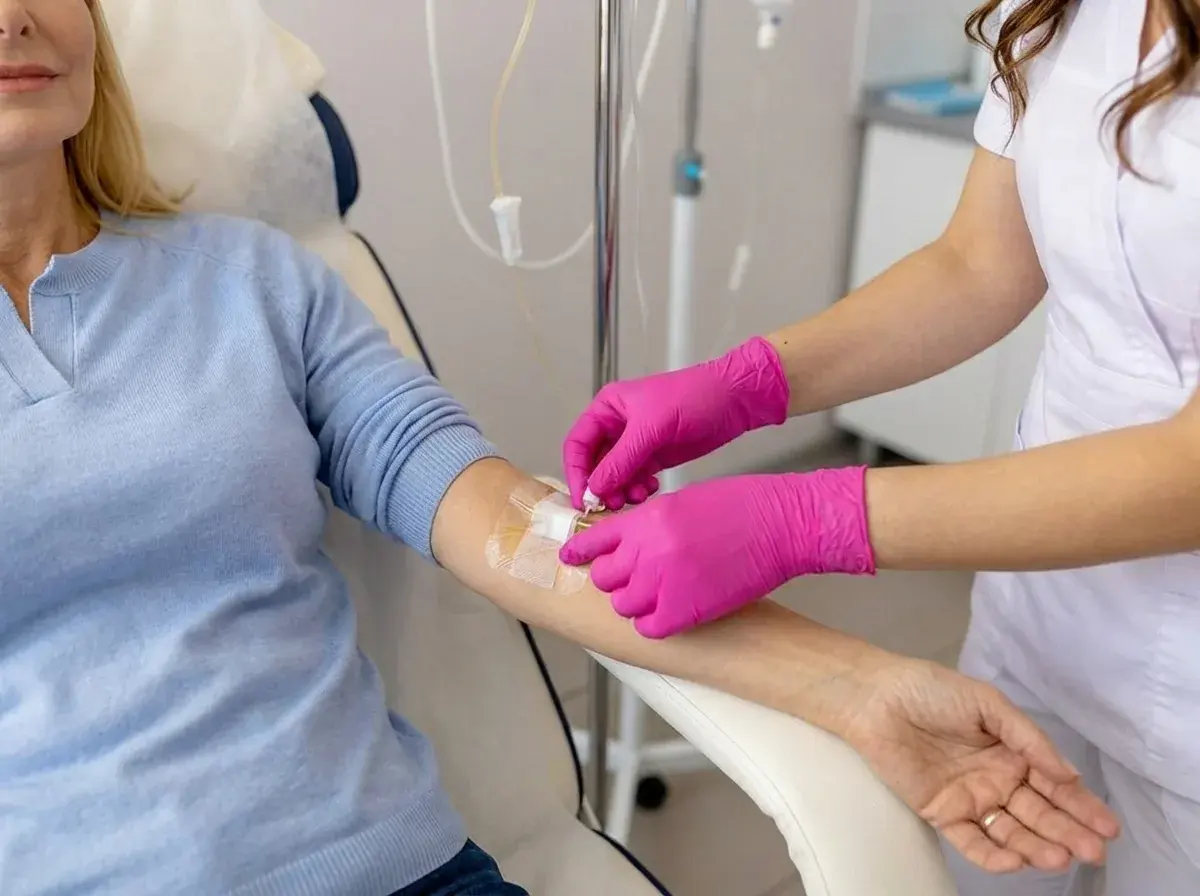
Choosing the best IV therapy in Pickering comes down to three clinical checks: who reviews your health history before the drip, who places and monitors the cannula, and what is in the bag and why. IV therapy delivers vitamins, minerals, amino acids and antioxidants directly into a vein, so it is a clinical procedure and the safeguards around it matter. Drip names on a menu answer none of those questions. This guide explains how IV therapy works, what to ask before booking, who should wait, and what a session involves at a Pickering clinic.
How IV therapy works
IV therapy delivers vitamins, minerals, amino acids and antioxidants directly into the bloodstream. A small peripheral cannula is placed in a vein, and the formula runs through it from the drip bag.
Because the infusion bypasses the digestive system, absorption is near-complete. For comparison, the absorption of most oral supplements is roughly 20 to 50%.
That route is also why IV therapy needs clinical safeguards. Nothing in the bag passes through digestion first, so the health history, the formula and the drip rate carry more weight than they do with a tablet.
Patients often ask about IV therapy alongside concerns such as low energy and fatigue or dehydrated, dry skin. The formula is matched to the goal, which is why the health intake always comes before the formula is chosen.
What happens during an IV therapy session
A session follows a fixed order, and each step is a checkpoint.
Normal activities can resume straight away. Drinking extra water for the rest of the day is the main aftercare instruction.
Some clinics also offer vitamin shots, which are a separate service. A shot is given intramuscularly, is smaller in volume and is quicker to receive than a drip.
- A health intake and contraindication review, completed before any formula is chosen.
- Formula selection, or customisation of a formula, based on your goals and history.
- Cannula placement, which takes 2 to 3 minutes.
- The infusion, which runs for 30 to 60 minutes while you stay seated.
- Removal of the cannula once the drip is finished.
What to look for in an IV therapy clinic
An IV clinic is easiest to judge on its process. These are the specifics worth checking before booking.
A menu of drip names says little about any of these points, so ask about each one directly.
- A health intake and contraindication review before the drip, with questions about pregnancy and digestive history.
- A registered nurse who places the cannula and monitors the drip, including vitals and the drip rate, for the full session.
- Medical oversight of the service, with the overseeing clinician identified by role.
- Sessions held in the clinic, where the drip can be watched from start to finish.
- A plain list of what each formula contains and why it was chosen for you.
- A recommended schedule based on your goals and how you respond.
- A practitioner prepared to delay or decline a drip when the intake raises a concern.
Questions to ask before your first drip
Clear answers to these questions show how a clinic screens, monitors and plans. Vague answers are useful information too.
- Who reviews my health history, and what would lead you to decline a drip?
- Who places the cannula, and who watches the drip once it is running?
- What is in this formula, and why does it suit my goals?
- Who manages the drip rate, and can it be slowed during the session?
- What should I tell you about my digestion or any bowel condition?
- How often would you recommend sessions for me, and why?
- Who provides medical oversight for the service?
Who should wait, or disclose first
Some health histories call for clearance or a pause before IV therapy. Each of the following belongs on the intake form, and the practitioner may decline to proceed.
Pregnancy, the postpartum window and active breastfeeding are treated as precautions. Each needs written clearance from an obstetrician or family physician before a drip. A bowel condition must be flagged at intake because high-dose Vitamin C, magnesium or a fast infusion rate can cause loose stools.
IV therapy also has limits worth stating plainly. It does not treat, cure or prevent any disease or condition, and it is not a weight-loss treatment. Anyone hoping for either outcome is better served by a conversation with their family physician.
- Pregnancy, and the first trimester in particular.
- The postpartum window.
- Active breastfeeding.
- A history of IBS, Crohn's disease, ulcerative colitis or chronic loose stools.
IV therapy at Victoria Rose Aesthetics in Pickering
Victoria Rose Aesthetics is an independent, RN-led clinic at 1870 Altona Rd, Unit A, in Pickering. Founder and lead injector Victoria Rose Cyr, RN, BScN, has more than ten years of clinical experience and leads the clinical standard. A Nurse Practitioner serves as Medical Director for regulatory oversight.
IV sessions are in-clinic only, with no at-home drips. A registered nurse places and monitors the drip, watching vitals and managing the drip rate, and the formula is selected for your goals under medical oversight. Four formulas are offered.
The drip names are labels for each formula's focus. The clinic describes Skin Glow as antioxidant and skin-brightness support and makes no medical treatment claim for any drip. A consultation is $75 for 30 minutes. Free on-site parking is available, and the clinic serves Pickering, Ajax, Oshawa, Scarborough and Durham Region. Directions are on the Pickering clinic page.
- Energy: B vitamins, magnesium and amino acids.
- Immunity: high-dose Vitamin C, zinc and antioxidants.
- Recovery: electrolytes, amino acids and B vitamins.
- Skin Glow: high-dose Vitamin C, glutathione and biotin.
Results, cadence and cost
Results from IV therapy are gradual and vary from person to person. Many patients notice more energy or hydration within hours of a session. Skin effects build more slowly, over 1 to 2 weeks with consistent sessions.
Cadence depends on the formula. Energy and recovery drips suit weekly or bi-weekly sessions. Glow and immunity drips are usually monthly. The practitioner recommends a schedule from your goals and your response, so two people on the same formula may follow different plans.
IV therapy is an elective service. It is not covered by OHIP or by most extended health plans, and a detailed receipt can be issued after each session.
Book a consultation in Pickering
A consultation is where the choice gets made for your anatomy and your history. Book a consultation at Victoria Rose Aesthetics in Pickering.
Victoria Rose Cyr, RN, BScN, is the founder and lead injector at Victoria Rose Aesthetics in Pickering, with more than ten years of clinical experience and over five years as a clinical trainer for Nuceiva and Teosyal.